
Reims Cathedral Stained Glass: The Windows You Shouldn’t Miss


Walk into Reims Cathedral and it is tempting to think of its stained glass as one great medieval collection. Look more closely, however, and you will find something much more unusual.
The stained-glass windows of Reims Cathedral span centuries. Some preserve the imagery of the 13th-century cathedral, while others were created after war damage left parts of the building without their historic glass. Modern artists including Marc Chagall and Imi Knoebel were invited to add their own work rather than simply imitate the Middle Ages.
The result is a cathedral where medieval kings, biblical scenes, Champagne vineyards and modern blocks of colour can appear within the same building.
UNESCO notes that Reims lost part of its original stained glass but still preserves remarkable examples of Gothic glazing. It also highlights the cathedral’s unusual combination of restoring medieval windows while commissioning contemporary artists.
If you are visiting Reims Cathedral, these are the windows worth looking for and the stories that make them significant.
Why Reims Cathedral’s stained glass spans eight centuries
The cathedral you see today was largely built from the 13th century onward, and stained glass formed part of its architecture from the beginning.
But Reims has endured centuries of damage and restoration. The most dramatic destruction came during the First World War, when the cathedral was repeatedly hit and a major fire broke out in September 1914. Parts of the historic glazing were lost or damaged.
The story did not end with reconstruction.
A particularly important part of that story is the Reims glassmaking dynasty associated with the Simon-Marq workshop. The City of Reims describes the workshop as central both to the restoration of historic stained glass and to many of the cathedral's modern commissions.
That is why the windows can feel so different as you move through the cathedral. You are not looking at one artistic moment. You are seeing successive generations responding to the same Gothic building.
The Great Rose Window
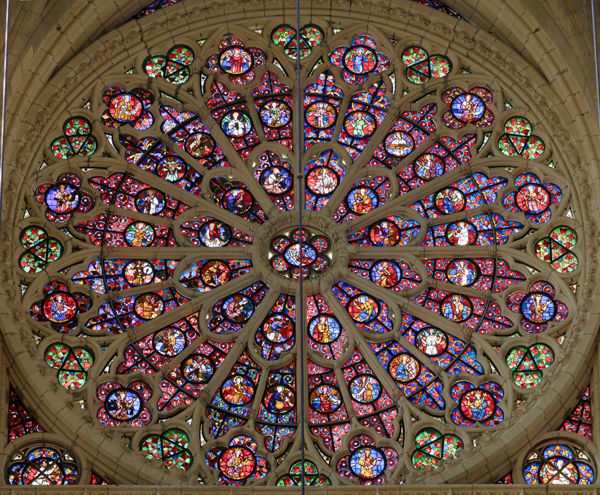
Turn towards the western entrance and look up at the two rose windows, one above the other. The larger window, known as La Grande Rose, draws your eyes towards its centre, then outwards through rings of figures and coloured glass. Beneath it, a smaller rose continues the same dedication to the Virgin Mary, bringing a twentieth-century contribution into this medieval setting.
The great rose dates from the second half of the thirteenth century. At its centre is the Dormition of the Virgin, the name given to Mary’s death, traditionally described as her “falling asleep”. Around her, twelve apostles form the first circle. Beyond them is a ring of twenty-four angels, many carrying musical instruments. Kings and prophets appear further out, while above the rose, Christ holds his mother’s soul. Together, these figures place Mary’s final earthly moments within a larger vision of heaven.
From the floor, the individual faces and instruments can be difficult to distinguish. Start with the overall arrangement: a central scene surrounded by successive circles, like the petals of a flower. Then try to pick out an apostle or an angel with an instrument. The glass rewards both ways of looking, first as a complete composition and then as a collection of small scenes.
There is another story hidden within the stone framework. Research undertaken during restoration dated the great rose to the second half of the thirteenth century and measured its diameter at approximately 11.3 metres. Its structure is unusually thick, ranging from around eighty centimetres to 2.2 metres. The stone divisions radiating from its centre were originally cut from enormous individual blocks, and iron reinforcement helped hold the whole arrangement together. What appears from below to be a delicate flower is also a substantial feat of medieval construction.
Now lower your gaze to the smaller rose above the central doorway. Jacques Simon created its stained glass in 1937 as part of the cathedral’s recovery after the First World War. Its subject is the Litanies of the Virgin, prayers that praise Mary through a series of titles and symbolic images. Mary appears in glory at the centre, surrounded by twenty-four medallions expressing these different aspects of her religious significance. The smaller window therefore continues the western wall’s Marian theme in a different visual language.
Keep these western windows in mind when you reach the north transept, because the subject there changes. Its thirteenth-century rose is devoted to Genesis. God the Creator occupies the centre, surrounded by scenes including the creation of Adam, Adam and Eve in Paradise, their expulsion, and the story of Cain and Abel.
These roses share a circular form, but each tells its own story. On the western wall, the imagery gathers around Mary. In the north transept, it turns to creation and humanity’s earliest biblical history. As you look between them, you can begin to read the cathedral’s windows as carefully arranged narratives, with each part contributing to the meaning of the building.
Look for the Champagne window

Look for the Champagne Window in the south transept of Reims Cathedral. Created in 1954 by master glassmaker Jacques Simon, it brings the vineyards, villages and wine-making traditions of the region into a building better known for royal coronations. Here, the story of Champagne becomes part of the cathedral’s religious imagery, connecting two identities that have shaped Reims for centuries.
Following the destruction of stained glass during the First World War, Champagne growers and wine houses sponsored this window. Simon, who came from a long line of Reims glassmakers, drew inspiration from medieval guild windows. In the Middle Ages, professional groups sometimes helped pay for church windows, and scenes of their work appeared alongside biblical stories. Simon revived that tradition, giving the people who produced Champagne a place within the cathedral’s continuing artistic story.
The window rises approximately ten metres and is divided into three tall sections called lancets, with circular openings, or oculi, above them. As you look across the glass, follow the journey from tending the vines to harvesting the grapes and making the wine.
In the left lancet, vineyard workers care for their vines under the protection of Saint Vincent, the patron saint of winegrowers. The central lancet shows the grape harvest, when a year’s work reaches its busiest stage and gathering the fruit becomes a shared effort. The right lancet follows the transformation of grapes into wine, with figures including Dom Pérignon, the cellar master associated with Hautvillers, and John the Baptist.
Look towards the lower scenes and borders, too. Simon included the supporting trades that make wine production possible, including bottle and cork makers. Winegrowers’ tools and the churches of forty-four Champagne villages also appear. These details turn the window into a portrait of a whole community, acknowledging the many hands and places behind the finished bottle.
Now let your eyes move upwards. The imagery shifts from human labour to biblical stories, inviting you to consider why wine belongs in a church as well as on a table.
Two men carry an enormous bunch of grapes from Canaan, recalling the abundance of the Promised Land. Within the window’s Christian symbolism, the suspended grapes also suggest Christ’s sacrifice. Another scene presents the “mystic wine press”, an image in which the pressing of grapes represents Christ’s suffering and the wine evokes his blood.
The Marriage at Cana adds another connection. In this biblical story, Jesus turns water into wine at a wedding feast. Bread, wine and a sacrificial lamb further develop the theme of the Eucharist, the Christian rite in which bread and wine are associated with Christ’s body and blood.
You do not need to identify every figure to understand the window’s central idea. The work taking place in Champagne’s vineyards is linked to the sacred use of wine. Simon places ordinary tools, seasonal labour and familiar village churches within that larger story. For Reims, it is a particularly fitting addition: a window that brings the surrounding countryside into the cathedral and gives local working life a place in its glass.
Marc Chagall’s windows

For many visitors, the most recognizable modern stained glass in Reims Cathedral is the group designed by Marc Chagall.
The three windows were completed in 1974 and occupy the axial chapel at the eastern end of the cathedral.
Their rich blues immediately distinguish them from much of the surrounding glass.
Chagall's Reims project developed through his collaboration with the Simon-Marq workshop. According to the City of Reims, his windows take up themes including sacrifice, the genealogy of the Virgin and biblical kings while using historic blue tones within a thoroughly modern composition.
This combination is part of what makes them work so well in the Gothic setting.
Chagall did not simply copy medieval figures and patterns. His imagery belongs unmistakably to the 20th century, but the colour allows the windows to speak to the older glass around them.
If you enter the cathedral primarily expecting medieval art, these windows are an important reminder that Reims Cathedral has continued to commission significant artwork long after the Middle Ages.
We will look at the individual scenes and symbolism of Chagall's windows in a separate guide, because they deserve much more attention than a brief section can give them.
Brigitte Simon and a quieter type of modern glass

Not every modern intervention in Reims Cathedral relies on intense colour.
Brigitte Simon Marq created several abstract windows using grisaille, a much more restrained approach to glass. The City of Reims specifically notes the contrast between these quieter windows and the more strongly coloured work elsewhere in the cathedral.
Grisaille typically relies on pale or lightly coloured glass, sometimes combined with painted detail, allowing more natural light to enter than heavily coloured stained glass.
That makes the experience quite different from standing before Chagall's deep blues.
The contrast is useful because it demonstrates that “modern stained glass” is not a single style. Reims Cathedral became a place where different artists could respond differently to the Gothic architecture rather than being forced to reproduce the visual language of the 13th century.
Imi Knoebel’s windows: medieval ideas in an abstract language

Some of the cathedral's newest stained glass sits close to some of its most famous.
In 2011, German artist Imi Knoebel created six windows for the apse, positioned on either side of Chagall's work. The commission formed part of celebrations marking the cathedral's 800th anniversary.
The result is dramatically abstract.
Rather than saints, kings or biblical scenes rendered as recognizable figures, Knoebel used intersecting areas of blue, yellow and red. The 2011 windows cover about 128 square metres.
Knoebel described the project as translating the iconography of the cathedral's old stained glass into a new abstract language.
That idea is worth keeping in mind while looking at them.
At first the windows can appear completely disconnected from medieval stained glass. But Knoebel was responding to the older windows rather than ignoring them. Colour itself becomes his subject.
There is another layer to the story.
In 2015, three further Knoebel windows were created for the Joan of Arc chapel. They were supported by a German cultural foundation with backing from Germany's Federal Foreign Office, a century after the cathedral had suffered devastating damage during the First World War.
The Ministry of Culture explicitly describes the project as a symbol of peace, shared construction and Franco-German friendship.
That makes these windows more than a contemporary art commission.
A cathedral badly damaged during German bombardment now contains stained glass by a German artist given partly as a gesture of reconciliation.
Few windows in the building connect its artistic history and its 20th-century political history quite so directly.
Which Reims Cathedral stained-glass windows should you see first?
If you have limited time inside the cathedral, concentrate on these:
Window | Where to look | Why it matters |
Great western rose | Western end of the cathedral | Major 13th-century rose associated with the Virgin |
North transept rose | North transept | Medieval Genesis imagery |
Medieval choir and nave glass | Look high above the choir and nave | Kings, archbishops, Apostles and the political-religious identity of Reims |
Champagne window | South transept | Combines vineyards, Champagne-making and biblical symbolism |
Chagall windows | Axial chapel | Famous 1974 modern windows known for their deep blues |
Knoebel windows | Apse beside Chagall | Abstract modern glass commissioned for the cathedral's 800th anniversary |
Later Knoebel windows | Joan of Arc chapel | Modern art tied to Franco-German reconciliation |
The best way to appreciate the windows is not necessarily to rush from one famous work to another.
Start with the medieval glass, then compare it with the 20th- and 21st-century windows. The differences in colour, figures, abstraction and light make the cathedral's long artistic history much easier to see.
Frequently asked questions about Reims Cathedral’s stained glass
Are the stained-glass windows in Reims Cathedral original?
Some medieval stained glass survives, but not all of the windows are original. Reims lost part of its historic glass through centuries of damage, particularly around the First World War, and the cathedral now combines surviving and restored medieval work with major modern commissions. UNESCO specifically highlights this mixture of Gothic stained glass, restoration and contemporary creation.
How old are the stained-glass windows in Reims Cathedral?
The collection spans roughly eight centuries. Important surviving windows date from the 13th century, while significant modern additions include Jacques Simon's Champagne window from 1954, Marc Chagall's windows completed in 1974, and Imi Knoebel's windows from 2011 and 2015.
Where are Marc Chagall’s windows in Reims Cathedral?
Chagall's three windows are in the axial chapel at the eastern end of Reims Cathedral. They were completed in 1974.
What does the great rose window of Reims Cathedral depict?
The great western rose forms a celebration of the Virgin and relates to the Marian sculptural programme of the cathedral's western façade.
What does the north rose window depict?
The north transept rose is devoted to scenes from Genesis.
Why does Reims Cathedral have modern stained-glass windows?
The modern windows are part of a deliberate approach that combines restoration of the cathedral's historic glazing with new artistic creation. Reims has commissioned modern artists rather than attempting to make every replacement window look medieval. UNESCO identifies this combination as part of the cathedral's continuing artistic history.
Who created the modern stained glass in Reims Cathedral?
Modern contributors include Jacques Simon, Brigitte Simon, Marc Chagall and Imi Knoebel. The Reims-based Simon-Marq workshop has played an especially important role both in conserving older stained glass and helping realize modern commissions.
Understand more of Reims Cathedral as you walk through it
The stained glass is only one layer of Reims Cathedral's story. The building also contains centuries of royal history, sculpture, wartime destruction, restoration and stories connected with the coronation of French kings.
Tourific's self-guided Reims Cathedral audio tour lets you hear those stories while standing in front of the places where they happened. You can follow the tour at your own pace and spend as much time as you want with the parts of the cathedral that interest you most.

Comments