top of page

Emperors Monks and Marx of Trier

4

( 1 reviews )

$6.99

WhatsApp Image 2025-02-18 at 10.33.58.jpeg
WhatsApp Image 2025-02-18 at 10.39.09.jpeg
building-6145831_1280.jpg
WhatsApp Image 2025-02-18 at 14.17.16.jpeg

Explore Trier on a short self-guided walk through ancient Roman monuments, grand basilicas, and one of Germany’s oldest cities shaped by over two millennia of history.

Highlights


  • Stand inside the largest surviving single room from Roman antiquity and spot the optical illusion emperors used to intimidate visitors

  • Hear how a Roman gold hoard worth a fortune lay hidden under a parking garage for eighteen centuries — until an excavator split it open

  • Trace the story of Trier's devastating witch trials, where a chief judge was destroyed by the very system he once enforced

  • Follow Karl Marx's roots from a rabbi's family in the Jewish quarter to the modest house where history's most famous critic of power was born

  • Learn why Trier's greatest monuments survived not by design but by accident — a monk's strange devotion, a dead man's wager, and a lie that turned out to be true

Preview Stop

Judengasse and the Judenpforte
00:00 / 01:04
This small stone archway doesn’t look like much, but it tells a very poignant tale. Look at the sides of the arch. You will see the anchor points that held a chain and a gate bar. This is the Kleine Judenpforte, the Minor Jewry Gate, probably built in the early thirteenth century. For centuries, this archway marked the entrance to Trier's Jewish quarter. In the previous stop, you saw a wealthy family's tower house with its door five metres off the ground. That was a choice and a status symbol dressed up as security. However, this gate was made for survival. Jewish communities had lived in Trier since Roman times, making it one of the oldest Jewish settlements in northern Europe. The fourteenth century heralded a golden age for Jewish life here, with about three hundred Jews living here, forming three percent of the city's population. They lived in these narrow streets, behind gates they could lock at night. In the late eleventh century, during the time of the First Crusade, tensions across Europe were running very high. The Crusade was a major military campaign launched by Western European Christians to capture Jerusalem and other holy sites from Muslim control. As groups of crusaders moved across Europe, a preacher known as Peter the Hermit arrived at the gates of Trier. He inspired strong religious excitement among the crowds, encouraging people to join the Crusade. But this intense atmosphere also led to violence. On the first day of the Jewish festival of Passover, Jewish communities in Trier became targets of attack. You might wonder — why were they affected when the Crusade was supposed to take place far away in the Holy Land? At that time, many crusaders saw Jews as “enemies at home.” There was a belief, rooted in misunderstanding and religious prejudice, that Jewish people were responsible for the death of Christ. Alongside this, there was also economic tension, as some Jewish families worked as moneylenders — a profession that was often restricted to them and sometimes resented by others. Because of these combined reasons — religious fervour, fear, and economic jealousy — Jewish communities in cities like Trier faced violence and persecution. So, the Jewish community in Trier fled to the archbishop's palace for protection. But under mob pressure, Archbishop Egelbert forced the remaining Jews to convert, including their leader, Rabbi Micah. Emperor Henry the Fourth later quietly permitted all of them to return to their faith. Then, as the Black Death, a deadly epidemic, was ravaging Europe, citizens targeted the Jews again. They attacked their Jewish neighbours, accusing them of poisoning the wells. The archbishop disposed of their property. The final blow fell in the early fifteenth century, when Archbishop Otto von Ziegenhain expelled all Jews from not just the city but the entire archdiocese. No Jewish community existed in Trier again for nearly two hundred years. There's one more connection worth knowing. The old Jewish cemetery outside the city walls contains the graves of Karl Marx's grandparents and great-grandparents. Marx's grandfather was a rabbi here. We'll come back to that story near the end of our tour. Follow the map till you emerge into a large, open square. That’s our next stop.
About this activity 


Free Cancellation 

  • Cancel up to 2 hours in advance for a full refund 

Valid 365 days 

  • Tour is valid for 1 year and can be used multiple times 

Language Options  

  • English | French | German | Spanish | Italian | Dutch | Polish | Russian | Portuguese

Duration  

  • 1 hour and 30 minutes

Starting point


Porta Nigra - Google Maps

OR

Download app for instant tour access

Screenshot 2025-02-24 at 5.10.26 PM.png
Screenshot 2025-02-24 at 5.10.32 PM.png
Itinerary
Porta Nigra
Stand before a Roman gate that survived only because a monk sealed himself inside it.
Dreikonigenhaus (House of the three Magi)
Look for the front door — then realise it was five metres above your head.
Judengasse
Pass through a narrow archway whose chain anchors held a community's survival.
Weinstand Trier Hauptmarkt
Find three civilisations stacked on a single column — and a pillory hidden at its base.
Saint Gangolf's Church
Hear how a widow's spire donation sparked an architectural arms race with the archbishop next door.
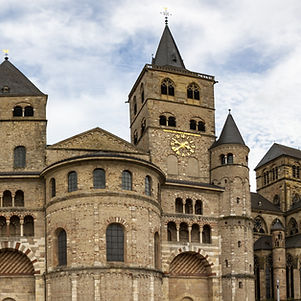
Trier Saint Peter's Cathedral
Search for the sixty-five-tonne stone the Devil supposedly hurled at the walls in a rage.
Liebfrauenkirche, Trier
Step inside a church saved from demolition by a claim about its builders that turned out to be true.
Frankenturm
Spot the upside-down Roman tombstone and consider why medieval builders inverted it deliberately.
Konstantin Basilika
Walk into the largest surviving single room from Roman antiquity — then look for the optical trick at the far end.
Electoral Palace
Stroll through gardens that exist because a dead man wagered against Catholic Trier's conservatism.
Rheinisches Landesmuseum
See the gold hoard that lay under a parking garage for eighteen centuries — split open by an excavator.
Kaiserthermen
Wander an imperial bath complex ambitious enough to rival Rome itself, yet never finished.
Karl-Marx-Haus
Trace how a rabbi's grandson born on this street became history's most famous critic of power.
Roman Bridge
Cross Germany's oldest bridge on pillars nearly nineteen hundred years old — and hear the general's reply that ended the debate.
Full Description
Walk through Germany's oldest city with a self-guided audio tour that traces two thousand years of power, survival, and unlikely accidents. From Roman gates and imperial throne rooms to witch trial sites and the birthplace of Karl Marx, Trier's story is one of empires built, dismantled, and buried — then rediscovered in the strangest ways. This tour follows fifteen stops across the compact old town, connecting the dots between the people who shaped this city and the monuments they left behind.
Important Information 


  • Instructions with link to app and how to access the tour will be sent to your email post checkout  

  • You can gain instant access to the tour by downloading the app and buying the tour on the app

Frequently asked questions

bottom of page