


Cursed Gold, Bricks and Pink Clay tour of Toulouse
Explore Toulouse on a short self-guided walk through pink-hued brick streets, bustling squares, and a city where aerospace innovation meets rich Occitan heritage.
4.9
( 7 reviews )
$6.99
Free Cancellation
Cancel up to 2 hours in advance for full refund

Walk by Tourific
Instant tour access


Highlights
Stand where a pastel merchant bankrolled a captured king's ransom — then visit the mansion his fortune built and never finished
Learn how one archaeologist's lie about Michelangelo saved a Renaissance masterpiece from demolition
Follow the street where a bull dragged a bishop to his death and gave half of Toulouse its place names
Hear how a wrongful execution in a sunny café square moved Voltaire to write the text that changed European tolerance laws
Taste the coiled sausage and candied violets that define Toulouse's food identity at one of France's oldest covered markets
Preview Stop
About this activity
Free Cancellation
Cancel up to 2 hours in advance for a full refund
Valid 365 days
Tour is valid for 1 year and can be used multiple times
Language Options
English | French | German | Spanish | Italian | Dutch | Polish | Russian | Portuguese
Duration
1 hour and 30 minutes
Itinerary
Place du Capitole
Stand before eight marble columns and ask why no single person could ever open the city's most important chest.
Donjon du Capitole
Peer up at a tower built from paranoia, where eight locks required eight keys turned simultaneously.
Couvent des Jacobins
Watch an entire Gothic ceiling balance on one impossibly thin column — then find who's buried beneath it.
Rue du Taur
Walk the street a bull dragged a bishop's body through — and learn where the animal finally dropped dead.
Eglise Notre-dame Du Taur Toulouse
Step inside the church built where the rope snapped and find a fourteenth-century family tree painted for people who couldn't read.
Basilique Saint-Sernin de Toulouse
Enter one of Europe's largest Romanesque churches and discover the controversy that sparked a century-long architectural war.
Jeanne d'Arc triomphante
Pause before the teenager whose courtroom answers left her own judges speechless.
Marche Victor Hugo Toulouse
Taste the coiled sausage that anchors Toulouse's most fought-over dish — and a candied flower a queen couldn't stop eating.
24 hour clock
Look up at a clock face where noon sits at the top, midnight at the bottom, and the hands move at half speed.
Place Saint-Georges
Sit in the café square where a sixty-four-year-old linen merchant was broken on the wheel — and Voltaire picked up his pen.
Cathedrale Saint-Etienne
Compare two churches awkwardly fused together and spot why locals call this the "unfinished cathedral."
Musee Des Augustins Toulouse
Hear how one archaeologist's most productive lie rescued a masterpiece across town from the wrecking ball.
Georges Bemberg’s Foundation — Hotel of Assézat
Follow a young heir from sudden fortune through religious war, public betrayal, and a mansion he never finished.
Basilique Notre-Dame de la Daurade
Meet a medieval Black Madonna who changes robes with the seasons — including haute couture by Gaultier and Lacroix.
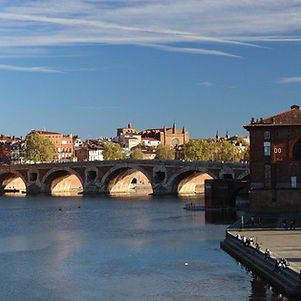
Pont Neuf
Cross the oldest surviving bridge in Toulouse and learn why it alone stood when floodwaters rose eight metres in a single night.
OR
Download app for instant tour access


Top Reviews
Full Description
Important Information
Instructions with link to app and how to access the tour will be sent to your email post checkout
You can gain instant access to the tour by downloading the app and buying the tour on the app


