Romans, Habsburgs and Mussolini of Trieste
Explore Trieste on a short self-guided walk through grand Habsburg squares, seaside promenades, and a city shaped by Italian, Slavic, and Austro-Hungarian influences.
4.7
( 3 reviews )
$6.99
Free Cancellation
Cancel up to 2 hours in advance for full refund

Walk by Tourific
Instant tour access


Highlights
- Stand on the pier where the destroyer that made Trieste Italian was Japanese by design and Scottish by birth.
- Walk into the square where Mussolini built a stage atop a Baroque fountain to announce his racial laws.
- Uncover how one imperial tax decision filled Trieste with Greek, Serbian, Jewish and Armenian merchants.
- Hear how a Hungarian veteran invented one of the first modern espresso machines right here in Trieste.
- Trace the three coloured bridges that accidentally arranged the Italian tricolour over a Habsburg port.
Preview Stop
About this activity
Free Cancellation
Cancel up to 2 hours in advance for a full refund
Valid 365 days
Tour is valid for 1 year and can be used multiple times
Language Options
English | French | German | Spanish | Italian | Dutch | Polish | Russian | Portuguese
Duration
1 hour and 30 minutes
Itinerary
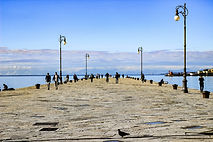
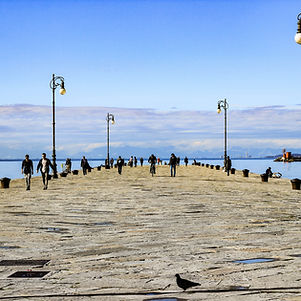
Molo Audace - Gia "Molo S. Carlo"
Stand on the pier whose namesake destroyer was Japanese by design and Scottish by birth.
Unity of Italy Square
Trace the bilingual plaque marking the spot where Mussolini chose Italy's largest seaside square for his worst speech.
Fountain of the Four Continents
Look up at the spirit of Trieste, vanished for thirty-two years to make room for a dictator's stage.
Caffè degli Specchi
Step inside the café whose engraved mirrors once chronicled the city, before invading armies looted them.
Palazzo del Municipio
Watch two black metal figures swing their hammers above the square at the top of every hour.
Arco di Riccardo
Pass beneath a Roman gate whose name comes from a king who was never here.
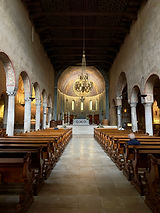
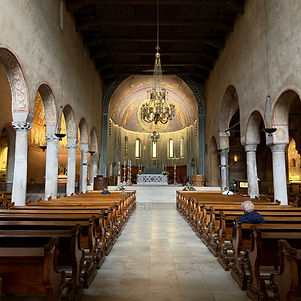
Cattedrale di San Giusto Martire
Find the seam where two early Christian churches were fused into one cathedral in the fourteenth century.
Castello di San Giusto
Climb the Habsburg fortress that never fought a war, but jailed an alchemist with a mercury cure.
Parco della Rimembranza
Walk a hillside that was once a Jewish cemetery, now a memorial of rough Karst stones.
Scala dei Giganti
Count the steps locals once accused of being built for a race of giants.
Roman Theatre of Trieste
Spot a two-thousand-year-old theatre that an entire neighbourhood was built on top of and forgotten.
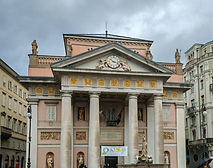
Piazza della Borsa
Discover the bronze emperor a Fascist regime took down, hid in storage, and quietly returned.
Libreria Antiquaria Umberto Saba
Browse the second-hand shop a poet bought the year the First World War ended.
Piazza del Ponterosso
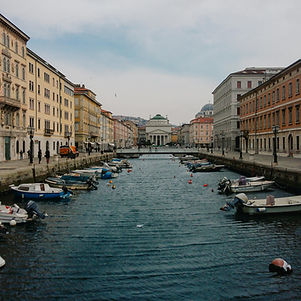
Encounter the red, white and green Italian tricolour, accidentally assembled by three Habsburg-era bridges.
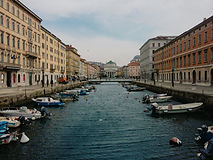
Canal Grande
Cross the canal Maria Theresa cut through a salt marsh to make Trieste the empire's main port.
Chiesa serbo-ortodossa della Santissima Trinità e di San Spiridione
See the blue and gold Serbian church whose congregation politely split from the Greeks after twenty-six years.
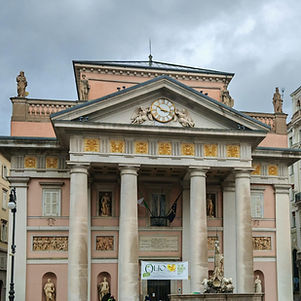
Church of Sant'Antonio Nuovo
Look for bullet marks inside a church where Allied police once opened fire on protesters.
Palazzo delle Poste Trieste
Examine two bronze cherubs delivering letters above the side doors of the grandest post office you will see.
OR
Download app for instant tour access


Top Reviews
Carter
Easy to use. Informative...
4 July 2026
Flier
Good self guided tour!
29 May 2026
Full Description
Important Information
Instructions with link to app and how to access the tour will be sent to your email post checkout
You can gain instant access to the tour by downloading the app and buying the tour on the app