
House of Heads Colmar (Maison des Têtes): History & 106 Faces


Walk along Rue des Têtes in Colmar, France, and you might notice something unusual about the building at number 19. Its windows are surrounded by carved stone faces. Some appear to smile, others grimace, and a few seem almost to be watching the people passing below.
There are 106 of them, according to Colmar's official heritage records.
This is the Maison des Têtes, or House of Heads, one of Colmar's most remarkable Renaissance buildings. Constructed in 1609 for a wealthy merchant, the house was designed to make an impression. More than four centuries later, its extraordinary façade still attracts attention.
But the faces are only part of the story. The building also tells us about the fortunes of Colmar's merchants, the ambitions of a prominent local family, and an unexpected connection to Auguste Bartholdi, the sculptor of the Statue of Liberty.
Here is what makes Maison des Têtes special, and what you should look for when standing outside it.
What Is the House of Heads in Colmar?
The House of Heads is a historic Renaissance townhouse at 19 Rue des Têtes, 68000 Colmar, in the old town of Colmar, Alsace.
In French, the building is known as La Maison des Têtes, meaning House of Heads.
Its name comes from the numerous sculpted faces and grotesque masks decorating the exterior. These appear around the windows and across the central projecting bay, creating one of the most unusual façades in Colmar.
The house was built in 1609, when Colmar was a prosperous imperial town within the Holy Roman Empire.
Unlike Colmar's familiar half-timbered houses, Maison des Têtes is particularly associated with German Renaissance architecture. Its elaborate stone decoration reflects the prosperity and ambitions of the wealthy merchants who helped shape the town.
Interestingly, the building became so well known that it eventually gave its name to the street. Rue des Têtes was named after the house in 1888, almost three centuries after its construction.
Why Does Maison des Têtes Have 106 Sculpted Faces?
The most obvious question is also the most interesting: why would someone decorate a house with more than a hundred strange faces?
Look closely and you will notice that the carvings are not identical. Some have exaggerated expressions, while others feature unusual facial characteristics and fantastic details.
These sculptures are generally described as grotesque masks, or mascarons. In Renaissance architecture, such decorative faces could be used to embellish buildings with humour, fantasy and visual surprise.
The carvings at Maison des Têtes are concentrated around the window frames, their stone divisions, and the central projecting bay.
Rather than following a simple, repetitive pattern, the decoration creates an impression of constant movement and variety.
Colmar's municipal heritage publication suggests that the façade was intended to display the wealth and ambition of its owner. Its decorative abundance was an unmistakable way to distinguish the house from its neighbours.
But did each face represent a particular person?
There is no well-established identification of 106 individual people behind the sculptures. Some interpretations suggest satire, humour or fantastic imagery, but assigning a specific meaning to every face would go beyond the available evidence.
The safest way to appreciate them is as an extraordinary example of Renaissance sculptural imagination.
A detail to look for: Stand on the opposite side of the street and examine the faces around the windows before concentrating on the central bay. You may find that the more closely you look, the more different expressions appear.
Are There 106 or 111 Faces?
You may come across two different numbers in travel guides.
The City of Colmar's detailed architectural heritage description and the Colmar Tourist Office's dedicated monument page both give the number as 106 heads or grotesque masks. Some other visitor guides say 111.
For this article, we use 106 because it is the figure supported by the principal official descriptions of the monument.
It is worth remembering, however, that parts of the façade have been restored over time. Not every visible carving is necessarily in its untouched original condition.
Who Built the House of Heads in 1609?
The house was commissioned in 1609 by Anton Burger, a prosperous merchant in Colmar.
Burger belonged to the wealthy commercial class that played an important role in governing the town. He later became one of Colmar's leading municipal officials, serving as Stettmeister, a senior civic office comparable to mayor.
His house was therefore more than a comfortable private residence. Its appearance communicated the position he had achieved in society.
The design is traditionally attributed to Albert Schmidt, an architect also associated with other important Renaissance buildings in Colmar.
The finished house was an ambitious statement.
At a time when architecture could communicate status as clearly as clothing or possessions, commissioning an elaborate stone façade was an expensive way to make success visible.
Think about the effect on someone walking along this street in the early seventeenth century. Instead of seeing an ordinary merchant's house, they encountered a building crowded with carved faces and decorative stonework.
Even in a town with prosperous merchants, it would have stood out.
The City of Colmar's heritage publication draws an interesting comparison with Maison Pfister, another famous merchant's house nearby.
Maison Pfister, completed in 1537, is noted for its painted decoration and humanist themes. Maison des Têtes, built more than seventy years later, places far greater emphasis on sculptural display.
Both reflect the wealth of Colmar's merchant class, but they express it in strikingly different ways.
The Architecture of Maison des Têtes
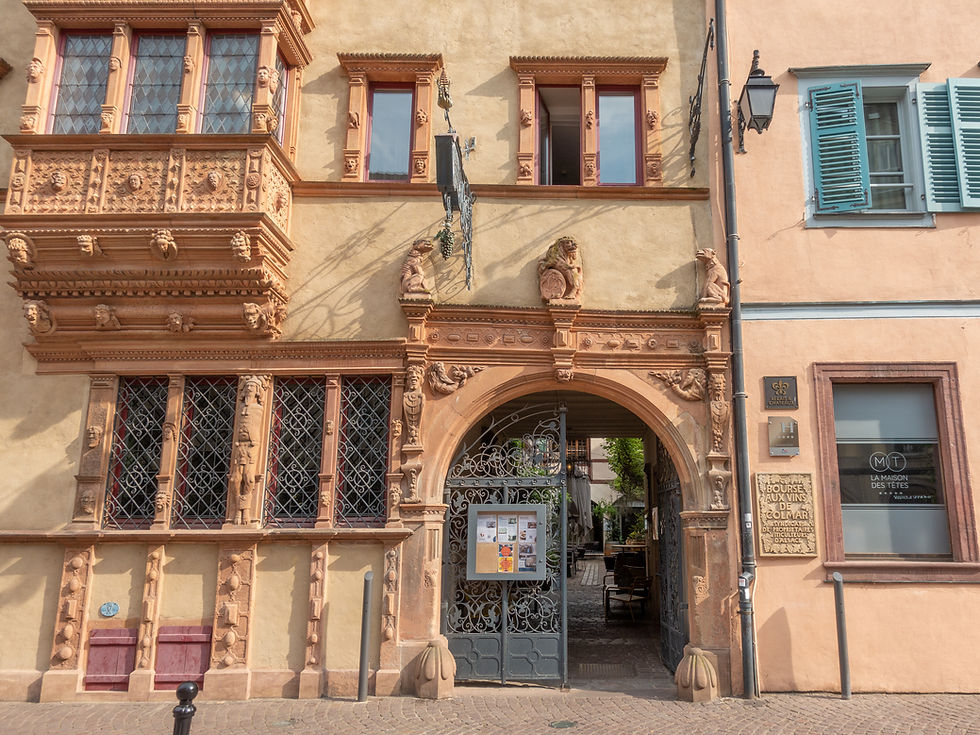
The House of Heads is one of Colmar's notable examples of German Renaissance architecture.
Its most important architectural features are best appreciated from the street.
The Central Projecting Bay
Look at the middle of the façade, where an elaborate bay window projects outward.
This type of projecting window is called an oriel. It allowed additional light into the building and gave its occupants a wider view of the street.
At Maison des Têtes, the oriel also became a major decorative feature.
The sculpted faces and ornamental details surrounding it draw attention towards the centre of the house.
The Window Frames and Stone Carvings
Now look at the areas between and around the windows.
Instead of plain stone divisions, you will find numerous carved faces.
These are not simply decorations placed randomly on a wall. They are integrated into the architectural framework, turning functional stonework into a sculptural display.
The result is a façade that rewards close observation.
The Curved Renaissance Gable
Finally, look towards the roofline.
The upper part of the façade is shaped with decorative curves and scroll-like forms, known as volutes.
This type of ornamental gable is characteristic of Renaissance architectural decoration in the region.
But there is one more feature at the very top, and it belongs to a much later chapter of the house's history.
The Bartholdi Statue on Top of the House of Heads

Look above the Renaissance gable and you will see a figure representing an Alsatian cooper, a craftsman who makes wooden barrels.
The statue was created by Auguste Bartholdi, the celebrated sculptor born in Colmar in 1834.
Bartholdi is best known internationally for designing the Statue of Liberty in New York Harbour. Yet some of his works can also be found in his hometown.
The cooper figure at Maison des Têtes was installed in 1902, almost 300 years after the building itself was completed.
So why was a barrel maker placed on top of a Renaissance merchant's house?
The answer lies in Colmar's wine industry.
In 1898, the building became associated with the local Wine Exchange, known as the Bourse aux Vins. The organization commissioned Bartholdi to create the cooper statue.
Barrels were central to wine production, storage and trade, making the cooper a fitting symbol of the building's new role.
The sculpture connected Maison des Têtes with the economy of Alsace's vineyards.
This also makes the house an unusual combination of two historical periods: an early-seventeenth-century Renaissance façade crowned by a work of art from the beginning of the twentieth century.
When you visit, don't stop looking after you have found the faces. Raise your eyes to the top of the building to find Bartholdi's contribution.
From Merchant's House to Wine Exchange and Luxury Hotel
Maison des Têtes has had several different lives since Anton Burger commissioned it.
Originally a prestigious private residence, it passed through different ownerships over the centuries.
Towards the end of the nineteenth century, it became closely associated with Colmar's wine trade when the Bourse aux Vins acquired the property.
This period also brought new attention to the building's historical importance.
In 1898, Maison des Têtes was officially classified as a French Historic Monument, helping protect its architectural heritage.
The building underwent restoration work in 2012, including attention to its historic façade.
Today, it is still occupied and serves a very different purpose from the one Anton Burger originally intended.
The historic property houses La Maison des Têtes, a five-star hotel, together with restaurants and other hospitality facilities.
Its continued use is part of what makes it unusual. Maison des Têtes is not an empty preserved townhouse or a conventional museum. It is a building that has adapted to changing circumstances while retaining its extraordinary exterior.
Where Is the House of Heads, and Can You Visit It?
Address: 19 Rue des Têtes, 68000 Colmar, France.
Maison des Têtes stands in Colmar's historic centre, within walking distance of the Unterlinden Museum, the Dominican Church and other important landmarks.
You do not need an admission ticket to appreciate the famous façade from the public street.
The interior, however, is occupied by a hotel and hospitality businesses. It is not a museum where visitors can freely walk through historic rooms.
For most travelers, the main attraction is the exterior architecture.
Allow a few minutes to observe the sculptures, the projecting bay and the cooper statue at the top.
If possible, look at the house from different positions along Rue des Têtes. The sculpted features are spread across the façade, and their details can be easier to identify from different viewing angles.
Discover More of Colmar's History on a Self-Guided Walking Tour
The House of Heads is just one example of the wealth and artistic ambition that shaped Colmar.
Other nearby buildings tell different parts of the same story. Maison Pfister, with its Renaissance paintings, shows another side of merchant culture. The Koifhus, Colmar's former customs house, reveals how the town's commercial economy was organized. Further through the historic centre, churches, fountains and old streets add more chapters to the city's history.
If you want to connect these places and understand their stories, Tourific offers a self-guided audio walking tour of Colmar.
The tour includes the House of Heads, Maison Pfister, Koifhus, Schwendi Fountain, Little Venice and other historic landmarks.
You can listen to the stories on your smartphone, follow the walking route at your own pace and use the tour offline after downloading it.
Frequently Asked Questions About the House of Heads
Why is it called the House of Heads?
The name refers to the 106 sculpted heads and grotesque masks decorating the building's Renaissance façade. The house became so famous that the street was named Rue des Têtes after it in 1888.
When was Maison des Têtes built?
The house was built in 1609 for the wealthy merchant Anton Burger. Its design is attributed to Albert Schmidt.
How many faces are on Maison des Têtes?
Colmar's official heritage descriptions generally identify 106 sculpted faces or grotesque masks. Some visitor guides report 111.
Who made the statue on top of the House of Heads?
The statue depicting an Alsatian cooper was created by Auguste Bartholdi, the designer of the Statue of Liberty. It was installed in 1902 for the Colmar Wine Exchange.
Can you enter the House of Heads in Colmar?
The building houses a hotel and restaurants rather than a public museum. Its historic façade can be viewed freely from Rue des Têtes, while interior access is associated with the businesses operating inside.
Is the House of Heads worth seeing?
Yes, particularly if you are interested in Renaissance architecture, unusual sculptures or Colmar's history. Its location in the old town also makes it easy to include on a walking tour.

Comments