top of page

Merchants and Mercenaries of Visby

4.9

( 28 reviews )

$8.99

WhatsApp Image 2025-02-18 at 10.33.58.jpeg
WhatsApp Image 2025-02-18 at 10.39.09.jpeg
building-6145831_1280.jpg
WhatsApp Image 2025-02-18 at 14.17.16.jpeg

Step into Visby on a short self-guided walk through medieval walls, cobbled lanes, and a Baltic island town rich in Hanseatic history and storybook charm.

Highlights
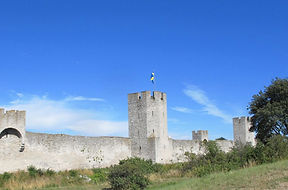
  • Discover why Visby's three kilometre medieval wall was built against fellow Gotlanders, not foreign invaders

  • Hear about a Lübeck friar who bought two waterfront brothels just to expand his church choir

  • Spot a Khazar silver coin reading 'Moses is the messenger of God' that reached Gotland by the Volga trade route

  • Stand on the burial field where the city gates stayed bolted while their countrymen were cut down outside

  • Find the craft brewery that copied a medieval ruin's arches onto its bottles and helped launch Sweden's modern beer scene

Preview Stop

Sankt Lars and Drotten
00:00 / 01:04
You are now standing between two ruined churches that look like sisters. The one on your right, with the Greek cross plan and the strange wall passages, is Sankt Lars. The one on your left, with the long, thin nave, is called Drotten. Local legend says that these two churches were built by a rich Visby merchant whose two daughters could not stop fighting with each other. Rather than choose between them, he built each daughter her own church, side by side, so they could worship separately. It is a sweet story, but it is not true. The truth is more interesting. These were two parish churches for two communities. Drotten, on your left, was the church of the German parishioners, built in the early thirteenth century, with delicate dog-tooth ornaments and a zigzag pattern in the stonework that you don't find anywhere else on Gotland. Sankt Lars, on your right, was probably the church of the Gotlanders. However, two parishes shared one cemetery. Now, look at Sankt Lars more carefully. Its plan is unusual and looks like the Orthodox churches of Novgorod, the great Russian trading city about a thousand kilometres east of here. Do you know why? Because Visby had a Russian merchant quarter. In the mid-thirteenth century, a treaty signed in the Russian city of Yaroslavl gave merchants of Novgorod the right to trade on what they called ""the Gotlandic Coast."" That meant Visby. Russian merchants lived in this city, and there was even a small Russian Orthodox church on the main square, of which only foundations remain. The name Drotten, by the way, comes from an Old Norse word for ""Lord,"" meaning God. There is no saint by that name. Both the churches were abandoned in the early sixteenth century, after the Reformation. When the Hanseatic system collapsed, even the German parish church got pulled apart by the people it had once kept at a distance. So, why did the system collapse? It wasn’t a single event, but a chain of setbacks. Trade shifted to mainland centres like Lübeck, reducing Visby’s importance. Then the Black Death, a deadly epidemic, devastated the population and economy. Soon after, Valdemar the Fourth of Denmark invaded, forcing heavy ransoms that drained the city’s wealth. Piracy added to the crisis, with the Vitalian Brothers attacking repeatedly, while political instability weakened trade. The final blow came in the early sixteenth century, when forces from Lübeck burned parts of the city. After three years, the people of Visby, furious at Lübeck for burning their city, sacked Drotten themselves and took its inventory home as ""rations."" The Reformation gave them the excuse, but the grief came first. Our next stop is right across the street. Follow the map to get there.
About this activity 


Free Cancellation 

  • Cancel up to 2 hours in advance for a full refund 

Valid 365 days 

  • Tour is valid for 1 year and can be used multiple times 

Language Options  

  • English | French | German | Spanish | Italian | Dutch | Polish | Russian | Portuguese

Duration  

  • 1 hour and 30 minutes

Starting point


Norderport -   Google Maps

Itinerary
Norderport (Northern Gate)
Observa los anillos de hierro aún incrustados en el arco de piedra caliza donde los defensores encadenaban el camino para cerrarlo.
Visby Town Wall
Sigue el trazado de tres kilómetros de muralla construida no para defenderse de extranjeros, sino de los propios compatriotas de la ciudad.
East Graves
Párate en el campo de enterramiento donde las puertas de la ciudad permanecieron cerradas mientras sus compatriotas eran masacrados al otro lado.
St. Nicolai Ruin
Entra en una estructura de ladrillo sin techo donde los primeros frailes dominicos de Suecia ocuparon las bóvedas durante casi tres siglos.
Visby Cathedral
Recorre la única iglesia de Visby que sigue en uso, financiada con un impuesto cobrado a cada barco mercante alemán.
S:t Lars gränd & S:t Drottensgatan
Haz una pausa entre dos iglesias en ruinas cuyos planos revelan que Visby tuvo en otro tiempo un barrio de comerciantes rusos.
Gotlands Bryggeri
Encuentra la cervecería artesanal que reprodujo los arcos de una ruina medieval en las etiquetas de sus botellas.
Christopher Polhems Staty
Conoce al habitante de Gotland cuya carrera comenzó reparando un reloj de catedral que llevaba cien años en silencio.
DBW's Botanical Garden
Pasea por un jardín financiado con las multas que doce jóvenes nadadores se imponían mutuamente por bañarse demasiado tiempo.
Fiskargrand
Recorre el callejón más fotografiado de Visby y descubre por qué sus famosas rosas trepadoras no son tan medievales como parecen.
Great Square
Busca en la gran plaza los restos de un convento construido donde antes hubo dos burdeles del puerto.
Wisby Ost AB
Sube al único lugar dentro de la muralla que conecta la parte alta y la baja de Visby sin salir nunca de la ciudad.
Adelsgatan
Camina por la calle cuyo nombre se ha interpretado erróneamente como «calle de los nobles» durante siglos, cuando en realidad significa «camino de la gente común».
Sankt Hans kyrkoruin
Observa la unión donde dos iglesias en ruinas comparten una misma pieza de piedra, una de tradición gotlandesa y la otra alemana.
Burmeister
Entra en la casa del siglo XVII del forastero de Lübeck que llegó a convertirse en uno de los hombres más poderosos de Visby.
Gotlands Museum
Busca la moneda de plata con la inscripción «Moisés es el mensajero de Dios» que llegó a Gotland por la ruta comercial del Volga.
Strandgatan
Pasa bajo los frontones escalonados de almacenes de piedra caliza de siete plantas donde antaño se almacenaban pescado seco y pieles rusas.
Almedalen Park
Termina en el parque del puerto, donde el mar se retiró y un joven Olof Palme dio inicio al mayor festival político de Suecia.

OR

Download app for instant tour access

Screenshot 2025-02-24 at 5.10.26 PM.png
Screenshot 2025-02-24 at 5.10.32 PM.png

Top Reviews

Ren

Visby

19 de julio de 2026
Excellent tour. We did fabulous tour in about 4 hours at a very leisurely pace. It ticked off all the must see stops and gave the right amount of information. Easy to use app.
Full Description
Walk Visby past cobbled alleys and twelve ruined churches to discover why its medieval wall was built against fellow Gotlanders, and how three disasters in quick succession froze this UNESCO town in time.
Important Information 
  • Instructions with link to app and how to access the tour will be sent to your email post checkout  

  • You can gain instant access to the tour by downloading the app and buying the tour on the app

Frequently asked questions

bottom of page