top of page
WhatsApp Image 2025-02-18 at 10.33.58.jpeg
building-6145831_1280.jpg
WhatsApp Image 2025-02-18 at 10.39.09.jpeg
WhatsApp Image 2025-02-18 at 14.17.16.jpeg

Strasbourg City self-guided audio walking tour

Stroll through Strasbourg’s charming streets and uncover a blend of half-timbered houses, riverside views, and centuries of Franco-German history woven into every corner.

4.6

( 7 reviews )

$5.99

Annulation gratuite

Annulez jusqu'à 2 heures avant la visite

Visite à pied par Tourific

Point de départ

Accès instantané à la visite

Highlights 


  • Hear how one man’s printing invention changed European history – but not in the way most people think

  •  Palais Rohan – power, prestige… and a scandal that still raises eyebrows

  • John Calvin’s Strasbourg years – why he came here and what changed because of it

  •  A battle few talk about – but without it, Strasbourg wouldn’t be the city it is today

  •  WWII liberation pledge – made thousands of miles away, fulfilled in these streets

  •  Start beside the cathedral and journey through centuries – Roman origins, medieval power struggles, religious reform and wartime resilience

Preview Stop

Gutenburg Square
00:00 / 01:04
We’re now standing in Place Gutenberg, one of Strasbourg’s most iconic squares — and fittingly, home to a statue of Johannes Gutenberg. Although Gutenberg was born in Mainz, Germany, it was here in Strasbourg in the mid-fifteenth century that he began experimenting with movable type printing — an invention that sparked a communication revolution. Before his innovation, books were copied by hand, often by monks, one letter at a time. His breakthrough was the development of small, reusable metal letters that could be arranged, inked, and pressed onto paper, allowing books to be produced faster, more cheaply, and in far greater quantities. You can see a prototype displayed beside the statue. A few years later, he used this technique to print what became known as the Gutenberg Bible — the first major book ever produced using movable type. Now look at the statue. Gutenberg is holding a sheet of paper that reads, in French: “Et la lumière fut” — “And there was light.” The phrase refers to the idea that printing brought light — the light of knowledge — to the world. Through printed words, ideas, education, and truth became accessible to ordinary people, not just the elite. Next, look at the plinth below the statue. You’ll notice four bronze bas-reliefs, each showing how printing influenced different parts of the world. On the front panel, Europe is shown crowded with great thinkers — Erasmus, Chaucer, Milton, Molière, Rousseau, Voltaire, Kant, and Schiller — representing the explosion of literature and philosophy that followed Gutenberg’s invention. To the right, the America panel features figures like Benjamin Franklin and the signers of the Declaration of Independence. It highlights how printing spread not just ideas, but also freedom — helping fuel new nations and democratic principles. To the left, the Africa panel depicts William Wilberforce and other abolitionists, using the printed word to fight slavery and raise awareness of injustice. Finally, though more weathered, the Asia panel portrays Brahmins exchanging manuscripts for books and Chinese scholars studying the works of Confucius — symbolising the meeting of ancient wisdom with modern technology. Each panel reminds us that from this very city — from Gutenberg’s hands — began a ripple that ultimately reached every corner of the world. Let’s move on to the next stop. As you arrive, look out for a statue holding a crossbow—that’s Reimbold Liebenzeller, the man who led the citizens against the Bishop’s army, as I mentioned in the second stop of our tour.
About this activity 

Free Cancellation 

  • Cancel up to 2 hours in advance for a full refund 

Valid 365 days 

  • Tour is valid for 1 year and can be used multiple times 

Language Options  

  • English | French | German | Spanish | Italian | Dutch | Polish | Russian | Portuguese

Duration  

  • 1 hour and 30 minutes

Itinéraire
Pont Couverts
Step onto the historic Ponts Couverts, a fortified bridge ensemble that has guarded Strasbourg since the Middle Ages.
Barrage Vauban
Explore the Barrage Vauban, a 17th-century defensive marvel that once shielded Strasbourg by flooding the plains against invading armies.
École Nationale d'Administration
Walk past the École Nationale d’Administration, the prestigious institution that has trained many of France’s top leaders and diplomats.
La Petite France
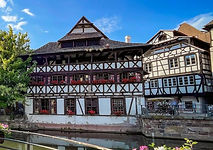
Stroll into La Petite France, Strasbourg’s most enchanting quarter, where half-timbered houses lean over calm canals like a storybook come to life.
Strasbourg
Admire Strasbourg’s distinctive half-timbered houses, their steep roofs and carved wooden frames reflecting centuries of Alsatian craftsmanship.
Restaurant Maison Des Tanneurs - Gerwerstub
Pause before the Maison des Tanneurs, a beautifully preserved 16th-century timbered house that once stood at the center of Strasbourg’s tanning district.
Mont Sainte-Odile
Hear the story of Saint Odile, the blind-born daughter miraculously granted sight and destined to become Alsace’s beloved patron saint.
Albert Schweitzer Statue
Discover the legacy of Albert Schweitzer, the Alsatian-born physician, philosopher, and Nobel Peace Prize laureate whose humanitarian work inspired the world.
St. Thomas Church
Step inside St. Thomas Church, a rare example of Alsatian Gothic architecture and the spiritual heart of Strasbourg’s Protestant community.
Place Gutenberg
Stand in Gutenberg Square, where the inventor of the printing press is honored at the very heart of Strasbourg’s historic center.
Maisons-Laffitte
Step into the Maison d’Alsace Biscuiterie, where traditional Alsatian baking fills the air with the warm scent of spices and butter.
Place des Tripiers
Pause at Place des Tripiers, a quiet square once home to Strasbourg’s medieval tripe merchants and bustling market stalls.
Palais Rohan
Admire the grand Palais Rohan, an 18th-century masterpiece once home to Strasbourg’s prince-bishops and a showcase of refined French Baroque elegance.
Cathedrale Notre Dame de Strasbourg
Begin your journey at the foot of Strasbourg Cathedral’s magnificent façade, where every carved figure hides a story from scripture, legend, or medieval life. As you move inside, you’ll uncover how Gothic ingenuity—ribbed vaults, soaring arches, and flying buttresses—shaped this landmark into a triumph of light and height.

OR

Download app for instant tour access

Screenshot 2025-02-24 at 5.10.26 PM.png
Screenshot 2025-02-24 at 5.10.32 PM.png

Meilleurs avis

Danielle

Strasbourg et son passé

3 juin 2026
Excellents commentaires sur l'histoire de la ville, en plus de l'identification des lieux visités. Le ton et le rythme de parole étaient excellents. Parfait.

Lyala

Façon amusante d'explorer une nouvelle ville

12 avril 2026
Nous l'avons fait en tant qu'équipe de quatre et nous l'avons tous vraiment apprécié. C'est une façon amusante de se promener à travers les points forts de la ville et de découvrir l'histoire et des faits intéressants. Les questions du jeu étaient également amusantes !

Eden

Une expérience agréable.

9 mai 2026
L'application est excellente. Nous avons déjà réservé des visites dans d'autres villes, et elles ont toujours parfaitement fonctionné. La visite de Strasbourg était bien conçue et divertissante. Il y avait beaucoup à découvrir, ainsi que de nombreuses histoires intéressantes. Le meilleur, c'est la flexibilité de gérer votre propre temps. Nous aimons nous promener et nous arrêter quelque part pour faire une pause quand bon nous semble. Ensuite, il suffit de continuer la visite. Un autre avantage est que, dans un grand groupe, il est souvent difficile de saisir toutes les informations. Si je manque quelque chose dans l'application, je peux simplement revenir en arrière et l'écouter à nouveau.
Full Description
Explore Strasbourg beyond the postcards. With your audio guide Alex in the Tourific app, embark on a self-paced walking tour through medieval streets, past royal residences, reformers’ homes, and hidden corners where history took surprising turns. This tour reveals how Strasbourg became a free city, a beacon of religious debate, a cradle of printing, and eventually, a symbol of liberation during World War II. You’ll hear stories that you won’t find on signboards or plaques—tales of secret negotiations, personal betrayals, miraculous healing, and bold promises made in the African desert that ended right here beside the cathedral. Just download the tour, put on your headphones and walk—no schedules, no groups, no rush. Along the way, you’ll also get tips on what to taste, where to pause, and which local legends deserve your attention. 👉 For curious travellers who don’t just want to see landmarks, but understand why they matter.
Important Information 


  • Instructions with link to app and how to access the tour will be sent to your email post checkout  

  • You can gain instant access to the tour by downloading the app and buying the tour on the app. 
bottom of page